
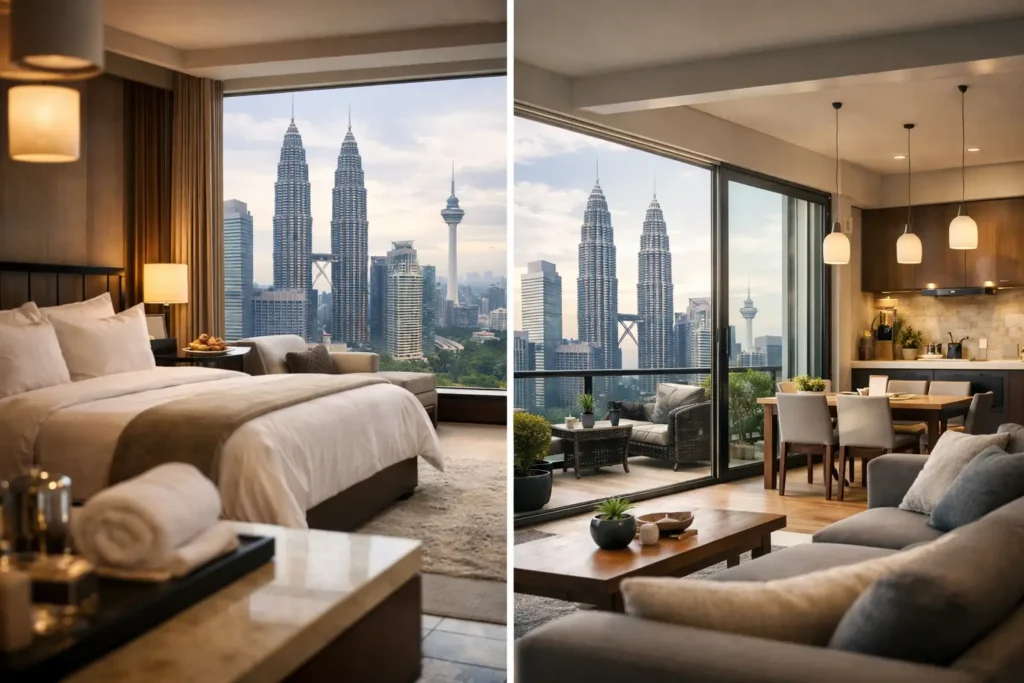
A late-night booking in Kuala Lumpur can go smooth or turn into a hassle fast, and the difference often comes down to one thing: hotel visit versus residence. If you are booking private companionship in KL, PJ, Bangsar, Bukit Bintang, or KL Sentral, the location is not a small detail. It shapes privacy, arrival speed, building access, security checks, comfort, and how discreet the whole session feels from start to finish.
For some clients, a hotel is the obvious move. Business travelers, short-stay visitors, and men who do not want personal addresses involved usually lean that way. For others, a residence feels easier, more relaxed, and more practical, especially if they live alone or have a private setup. There is no fake one-size-fits-all answer here. The right choice depends on your building, your timing, your budget, and how much control you want over the environment.
Hotel visit versus residence – what really changes?
On paper, both options give you a private place to meet. In reality, they operate very differently.
A hotel visit usually works best when convenience and neutrality matter most. Hotels are built for guests coming and going. In busy KL areas like Bukit Bintang or KL Sentral, that flow can help you blend in. If you are staying in a reputable hotel, have your booking details ready, and understand the guest policy, the process is often simple. You get a controlled setting, front desk support if needed, and no need to share your home address.
A residence can feel more comfortable because it is your own space. There is no check-in desk, no lobby cameras you are thinking about, and no worry about whether the hotel allows visitors after a certain hour. If you live in a condo or private unit and know the access process well, residence bookings can be faster and more relaxed. But this is where details matter. Some condominiums in Kuala Lumpur and Selangor have strict guard procedures, visitor logs, lift access cards, and security calls to the unit. That can slow everything down or make the arrival awkward.
So when people compare hotel visit versus residence, the real issue is not just place. It is friction. Which setting creates less friction for the booking you want right now?
Why many KL clients prefer hotel visits
Hotel visits are popular for a reason, especially among tourists, business travelers, and men staying near nightlife or transport hubs. If you are already checked into a hotel in central Kuala Lumpur, a booking can feel cleaner and easier to manage. You are in a temporary space. You leave no personal trail beyond your room booking. When the session is over, that is it.
Discretion is a major factor. A hotel lobby may look public, but it also gives anonymity. Nobody there knows your personal life. In a busy property, guests, visitors, and staff activity blend together. Compare that with walking someone through a residential guardhouse where your unit number, tower, and name may all come into play.
Hotels also help when you are only in town for a short time. If your schedule is tight and you want immediate access in areas like Bangsar, Petaling Jaya, or Shah Alam, a hotel outcall can be more practical than organizing a private residential meetup. For high-intent users who want fast service with less back-and-forth, that matters.
That said, not every hotel is ideal. Budget hotels can be hit or miss on guest friendliness. Some premium hotels are excellent for privacy, while others are strict about registered visitors. Some require ID at the desk or limit late-night access. Before confirming anything, know your hotel policy. A five-minute check can save a messy arrival.
When a residence is the better option
Residence bookings work well when the client has full control of the space. If you live alone, know your building rules, and can provide clear instructions, home can be the more comfortable option.
The biggest advantage is familiarity. You are in your own environment, which can make the experience feel less rushed. There is no hotel checkout hanging over you, no concern about noisy corridors, and no extra room charge if you were considering booking a hotel just for the meetup.
For locals in Subang Jaya, PJ, Shah Alam, or residential parts of KL, a residence can also be more efficient. If traffic is heavy and the companion is already covering your area, going to your own place may save time compared to coordinating a separate hotel booking.
But residence only works when access is actually smooth. High-rise condos with strict security can be more complicated than hotels. Visitor registration, guard calls, parking confusion, and elevator restrictions are common problems. If your building is known for delays, the booking starts with irritation instead of comfort. In those cases, paying for a decent hotel nearby may be the smarter move.
Privacy is not always what people think
A lot of clients assume home is automatically more private. Sometimes it is. Sometimes it is the exact opposite.
At a residence, privacy depends on who lives nearby, who shares the property, and how the building handles guests. If you have roommates, family, nosy neighbors, or a guard who questions every visitor, home is not the private option you think it is. Even landed properties can create exposure if parking, gates, or street visibility become an issue.
Hotels create a different type of privacy. You are not exposing your real home base. You are using a temporary location with professional staff and predictable systems. For travelers and married men especially, that separation can be the whole point.
This is why hotel visit versus residence is often really a privacy strategy. Do you want distance from your personal life, or do you want total control over your own space? The answer changes from client to client.
Cost, timing, and convenience trade-offs
Money matters, but not always in the obvious way. A residence may seem cheaper because you are not paying for a room. That is true if you already have a suitable place and access is easy. If your building creates delays, if parking is difficult, or if the companion has to spend extra time navigating security, the cheaper option can become the more troublesome one.
A hotel adds a direct cost, but it can buy simplicity. If you are in town for one night, staying near the action, and want a direct outcall booking without exposing your residence, the hotel fee may be worth it. It can also help with timing. In high-traffic KL windows, keeping the meetup close to the companion’s service area matters.
Convenience also depends on readiness. If your hotel room is booked, checked in, and guest-friendly, that is efficient. If you are still deciding between properties, waiting for check-in, or stuck with a hotel that questions every visitor, it becomes slower than home.
How to decide fast without making it messy
If you want the strongest option, stop thinking about what sounds better and think about what will run cleaner tonight.
Choose a hotel if you are traveling, want discretion away from your personal address, need a neutral space, or know your residential building is a security headache. Hotel is also the stronger play when you want central access in busy zones and do not want unnecessary complications.
Choose a residence if you have a genuinely private setup, easy entry, no household interruptions, and enough confidence that the arrival will be smooth. Home works best when comfort matters more than neutrality and when your building does not create friction.
If you are unsure, ask yourself a blunt question: where is the booking least likely to get delayed, questioned, or exposed? That answer is usually the right one.
For clients using a local platform like KL Escort Call Girl, this decision matters because speed and availability only help if the final location works in real life. The best booking is not just about choosing the hottest profile. It is about choosing the setup that protects your time, your privacy, and your mood.
Hotel visit versus residence for travelers and locals
Travelers usually win with hotels. It fits the short-stay lifestyle, keeps things discreet, and avoids giving out personal details in a city where you may only be around for a night or two. If you are flying in for work or staying near nightlife districts, hotel is often the cleanest option.
Locals have more flexibility. Some will still prefer hotels for privacy. Others with private condos or homes will choose residence because it is easier and cheaper. Neither option is automatically premium or low-end. What matters is how well it matches the situation.
The smart move is simple: pick the location that reduces risk and keeps the booking smooth. A premium experience starts before anyone arrives, and the right setting does more for discretion and comfort than people admit.