
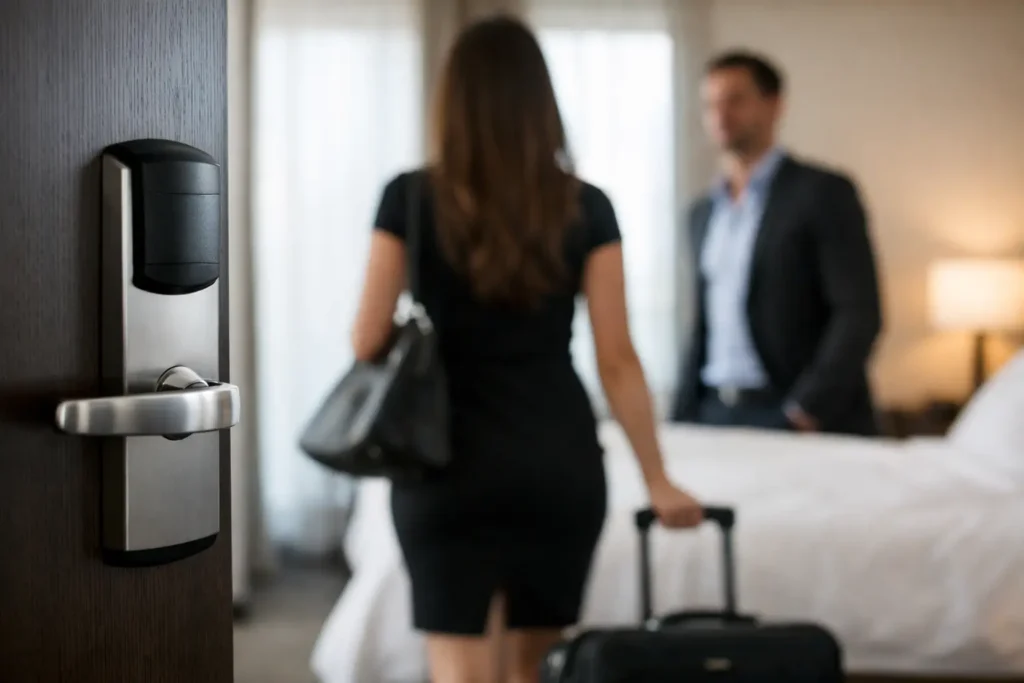
A hotel room may be the most convenient place for an outcall, but do outcalls require hotel access every time? No. Hotel access is not automatically required, and it is never something to assume. The real issue is whether the venue allows visitors, whether the registered guest can receive one, and whether both adults can meet privately, legally, and comfortably.
For travelers in Kuala Lumpur, this question comes up often because hotels have very different guest policies. A high-end property in Bukit Bintang may have a staffed lobby, key-card elevators, and strict visitor registration. A serviced apartment in Mont Kiara or a private residence in Petaling Jaya may have a different process entirely. Convenience matters, but following the property rules matters more.
Do Outcalls Require Hotel Access? Usually, It Depends
An outcall simply means an adult companion travels to an agreed location instead of hosting at her own location. That destination could be a hotel, serviced apartment, private residence, or another lawful private setting. So hotel access is common, especially for business travelers and short-stay visitors, but it is not a universal requirement.
What cannot be treated casually is entry. A guest should have clear permission to invite a visitor. The visitor should not be asked to bypass lobby staff, use another guest’s key card, claim to be someone they are not, or enter through restricted access points. Those shortcuts create stress, security risks, and potential trouble for everyone involved.
A straightforward arrangement starts with a straightforward answer: can your accommodation legally and comfortably accept a visitor? If the answer is unclear, confirm the policy before making plans. A premium room does not always mean unrestricted guest access, and a budget property does not always mean a relaxed policy.
Hotel Rules Can Change the Plan
Hotels set their own rules around outside visitors. Some allow guests to meet visitors in the lobby and then proceed to the room. Others require the visitor to show identification at reception, register with security, or leave before a certain hour. Some properties limit overnight visitors, charge an additional occupancy fee, or permit only the people listed at check-in.
These rules are not personal. They are usually connected to building security, insurance, occupancy records, and local compliance requirements. Ignoring them can result in a visitor being denied entry, the registered guest being warned, or both parties being asked to leave.
Before arranging an outcall at a hotel, check three practical points: whether visitors are permitted, whether photo ID registration is required, and whether there are restrictions on overnight guests. You do not need to provide a long explanation to hotel staff. Simply ask about the visitor policy for a registered guest.
Key-card elevators and staffed lobbies
A key-card elevator is not a barrier if the property permits visitors and the registered guest meets them appropriately. It becomes a problem when someone expects a visitor to follow another guest upstairs or evade security. That is a bad plan, full stop.
Staffed lobbies also affect timing. If discretion is a priority, choose a location where you can meet calmly, communicate clearly, and follow the front desk process without confusion. Turning up at a property with no confirmed visitor policy is how a simple evening becomes an awkward negotiation in public.
ID requirements are normal at many properties
In Kuala Lumpur, hotels and residences may ask visitors for identification. This is especially common at luxury hotels, managed residences, and buildings with 24-hour security. A request for ID should not be treated as a surprise or a reason to pressure anyone into proceeding.
Adults should be prepared to make their own decisions about identification and privacy. If a venue’s requirements do not work for either person, choose another lawful arrangement rather than trying to get around the policy.
Alternatives When Hotel Access Is Not Available
If a hotel does not allow visitors, the answer is not to force the situation. There are other options, but each requires the same level of respect for property rules and personal boundaries.
A private residence can work only when the host has the right to receive visitors and the setting is genuinely private. Shared housing, family homes, dormitories, and buildings with strict management policies may not be suitable. A serviced apartment may allow guests, but many have registration rules similar to hotels, particularly in areas such as Bangsar, Puchong, Shah Alam, and KLIA-linked accommodations.
Meeting first in a public place can also be a sensible choice when both adults want to confirm comfort and communication before heading to an approved private location. A hotel lobby, café, or restaurant is useful for a brief, low-pressure introduction. Public venues are for meeting and conversation, not for any activity that violates venue rules or local law.
The strongest option is not necessarily the closest address. It is the location where access is permitted, expectations are clear, and neither person feels rushed or exposed.
Privacy Is Not the Same as Secrecy
Many travelers ask about hotel access because they want privacy. That is reasonable. Privacy means choosing a lawful setting, keeping personal details limited, and respecting each other’s confidentiality. Secrecy, on the other hand, can involve evading staff, misleading security, or creating a situation where one person feels unsafe. Those are not the same thing.
Good planning protects privacy without demanding deception. Use clear communication about the venue, arrival time, visitor procedure, and any building restrictions. Do not share room numbers widely. Do not post another person’s location or personal information. Do not bring unapproved extra guests to a private meeting.
For an adult companionship arrangement, discretion should feel calm and organized, not tense. If the plan requires hiding, sneaking, or arguing with building staff, it is not a strong plan.
Consent, Safety, and Clear Expectations Come First
Hotel access is only one part of an outcall. The more important foundation is that every person involved is a consenting adult and free to leave at any point. No payment discussion, travel time, reservation, or prior message removes anyone’s right to say no, change their mind, or end the meeting.
Confirm basic details before anyone travels: the general location, the expected arrival window, the visitor policy, and whether the meeting is still wanted by both parties. Keep communication respectful and direct. Pressure, threats, intoxication, or attempts to change agreed terms at the door are clear signs to stop.
A safe meeting also means respecting personal belongings and boundaries. Never photograph or record another person without explicit permission. Never ask someone to hand over identification, a phone, or valuables. If either party feels uncomfortable, leaving is the right call.
Local Rules Matter in Kuala Lumpur
Travelers should remember that hotel policy is not the only consideration. Malaysia has local laws and cultural expectations that may differ significantly from those in the United States or other travel markets. A visitor’s home-country assumptions do not override local law, building rules, or hotel terms.
That is why responsible adults should understand the rules that apply to their stay, particularly when arranging private meetings in hotels, residences, or short-term rentals. When there is uncertainty, choose the conservative option: follow the venue policy, avoid public disruption, and do not proceed with anything unlawful.
For international guests, the practical lesson is simple. A room reservation gives you a place to stay, not unlimited authority to bring in visitors under any circumstances. Read the terms, ask the front desk, and avoid putting staff or another person in a difficult position.
A Better Way to Plan an Outcall Location
The best outcall location is one confirmed before travel, not improvised at the lobby. Be honest about whether you are in a hotel, residence, or serviced apartment. Confirm that visitors are allowed and disclose any check-in, ID, elevator, or security procedures that may affect arrival.
If the venue is not suitable, say so early. Rescheduling, choosing a permitted location, or deciding not to meet is far better than creating a last-minute access problem. Clear details protect time, privacy, and personal comfort.
Hotel access can make an outcall easier, especially for visitors staying in central Kuala Lumpur, but it is not a guaranteed right and not the only option. Choose a lawful, approved setting where both adults can communicate openly and leave without pressure. That is the kind of discretion that actually works.